Methionine: The Last Fortress of Bio-Manufacturing & The Battle for Sulfur | CanChem
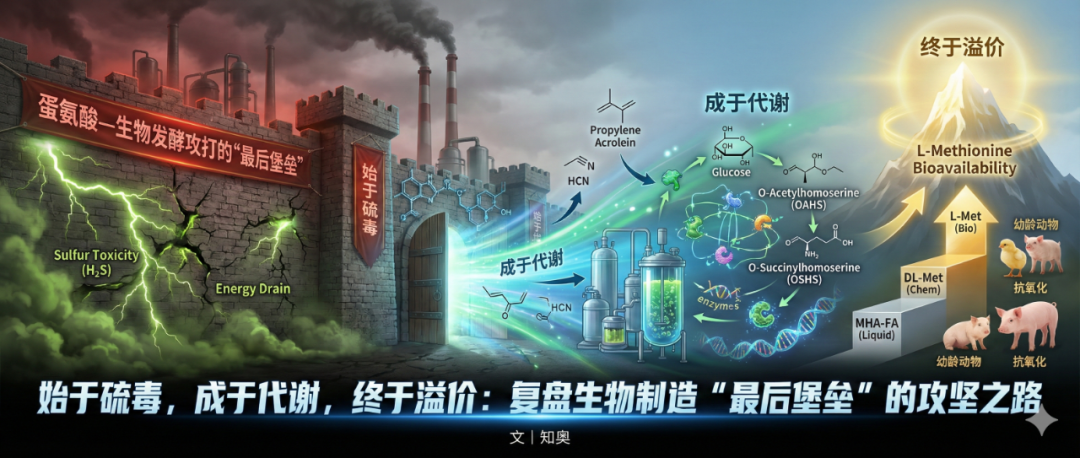
In the landscape of amino acid bio-fermentation, if lysine was the “Normandy Landing,” methionine is the unbreached “Berlin Wall.” As the only sulfur-containing essential amino acid, it has long been guarded by chemical giants likeEvonik and Adisseo. In November 2024, the completion of the world’s largest single-train liquid methionine plant by Sinopec and NHU once again reinforced this fortress.
Behind this lies the double moat of “Sulfur Toxicity” and atomic economy. While other amino acids have succumbed to bio-manufacturing, methionine remains heavily reliant on petroleum-based synthesis.
The “Rigid Payment” in Feed: From Limitation to Fortress
If lysine is the “King of Volume,” methionine is the “King of Profit & Barriers.” It is the first limiting amino acid for poultry (due to sulfur-rich keratin in feathers) and essential for aquaculture. Unlike other amino acids, its demand is rigid and irreplaceable, often called the “Rigid Payment” in feed formulation.
Market Scale
Global capacity hit 2.6 million tons by end-2024. Despite steady demand growth (1.8M tons), the industry faces a brutal “survival of the fittest” with utilization rates around 75–80%.
Oligopoly Club
CR5 > 80%. The game is dominated by Evonik, Adisseo, NHU, and Novus. NHU has recently surged to become the global No.3 player (~500k tons).
Route Battle: Biology vs. Chemistry
Why does80% of methionine still rely on petro-chemistry? The answer lies in the 16th element: Sulfur.
Biological Nightmare: Introducing sulfur into cells creates toxic H₂S and sulfites, inhibiting respiration. Moreover, reducing sulfate consumes massive energy (ATP / NADPH), making the bio-yield naturally lower than glutamate.
Chemical Moat: Giants like Evonik and NHU control the dangerous supply chains of Acrolein (explosive) and HCN (toxic). This vertical integration creates an immense barrier to entry.
The Breakout: CJ’s Trojan Horse & Huaheng’s Precursor
CJ CheilJedang (Korea) deployed a smart “Two-Step Strategy”: fermentation for the carbon skeleton (OAHS), and enzyme catalysis for sulfur introduction. This avoids intracellular sulfur toxicity.
Huaheng (China) is taking a different path with Academician Zheng Yuguo. They utilize OSHS as a precursor. The genius lies in “Co-production”: enzyme hydrolysis produces Methionine + Succinic Acid (a high-value bioplastic monomer). This economic model could rival chemical efficiency.
The Physiological Counterattack: L-Met Premium
Chemical DL-Met is a50/50 mix. Animals must convert the D-form to L-form, generating toxic peroxides (ROS) and stressing the liver. This is the Achilles’ heel of chemical methionine.
L-Methionine (Bio-based) Advantage:
- Young Animals: Chicks / Piglets lack the enzyme to convert D-Met efficiently.
- Heat Stress: Avoiding D→L conversion reduces oxidative stress on the liver.
- Data: Relative Bio-Availability (RBA) is 120%–140% compared to DL-Met.
Future Outlook: Dual Tracks
The fortress is cracking, but not falling. We predict a “Dual Track” future:
- Commodity Market: NHU andEvonik will rule the cost-driven bulk market with chemical efficiency and vertical integration.
- Functional Market: Bio-based L-Met (CJ, Huaheng) will dominate high-end segments (starter feed, pets) where functionality justifies the premium.
Interested in Learning More?
Contact our team for technical specifications, sampling, or partnership inquiries.